
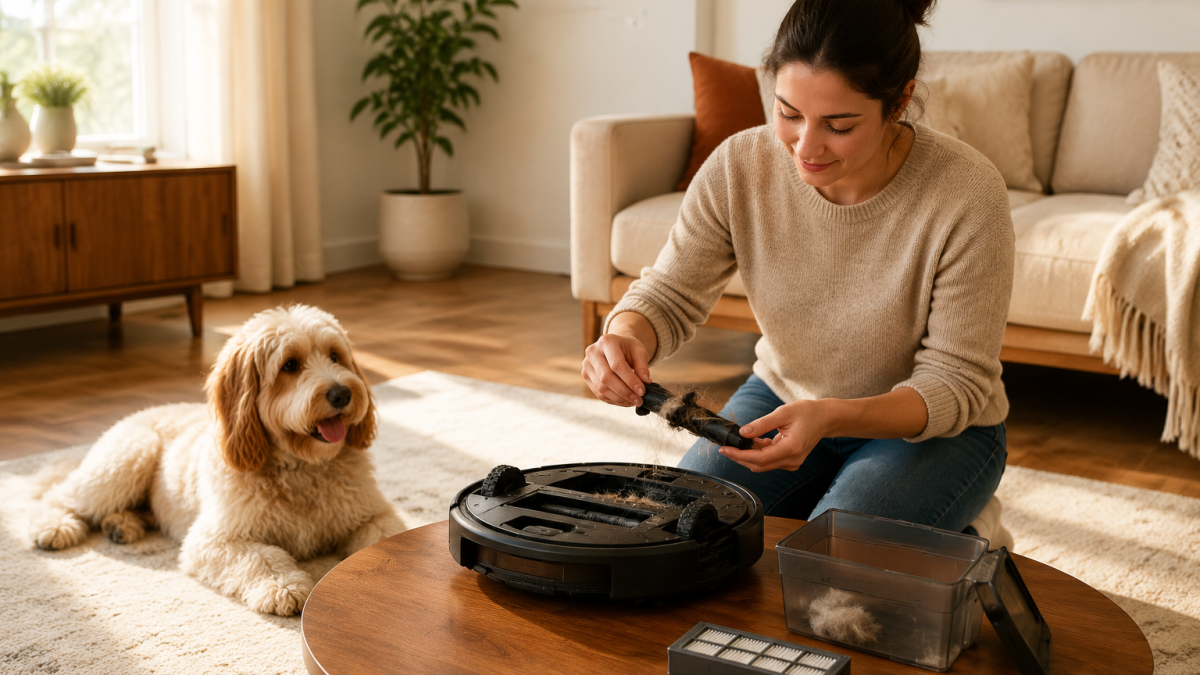

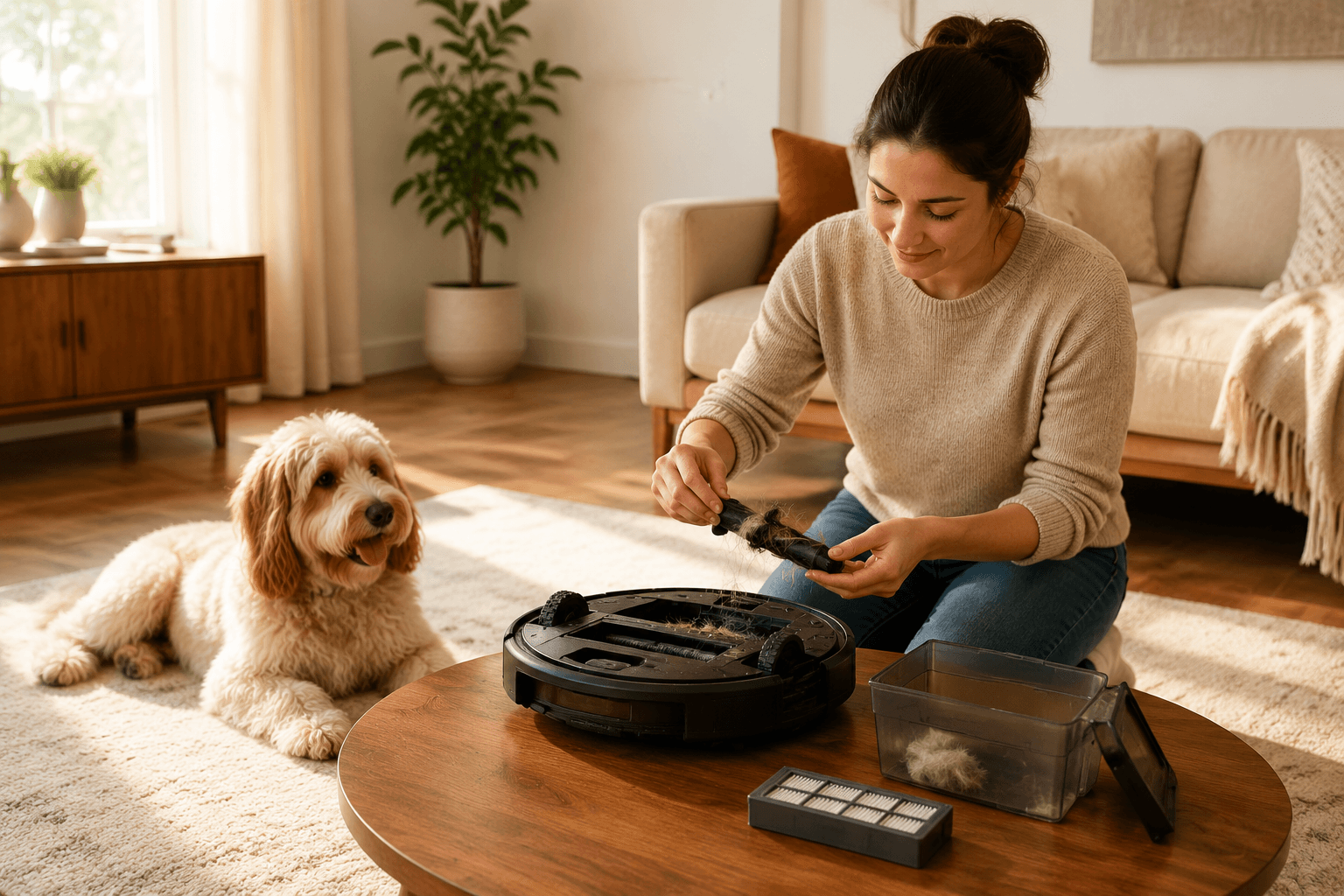
 Most manufacturer guides suggest cleaning the roller brush every week or two. That estimate is built for a household without pets. One medium-shedding dog can move as much hair through a robot vacuum for pets in a single day as a pet-free home produces in a week. The schedule that ships in the box is not the schedule that keeps up.
There is no single right interval for every pet household, either. One dog on a hard floor is a different situation from two cats on carpet in the middle of spring shedding.
Each component in this article has its own pace, and that pace shifts with the season. This article breaks down how often to clear the roller brush, when a filter needs replacing, how to keep the dustbin from turning into an odor source, what side-brush wear looks like, and how to schedule runs around pets.
Table of Contents
- Roller brush and how often to clear it when pets are home
- Filter clogging and when to replace rather than clean
- Dustbin emptying and odor management
- Side brush wear that pet owners tend to overlook
- Scheduling runs when your pet is still in the room
- Conclusion
Roller brush and how often to clear it when pets are home
Hair does not just collect on top of the roller brush. It works into the bearing caps at both ends of the shaft, and that is where resistance builds. A brush that spins fine when new can start dragging or produce a faint burning smell when the shaft ends are packed. Most owners notice the noise or the reduced pickup first, not the root cause.
In a household without pets, light weekly attention usually keeps the brush clear. One medium-shedding dog changes that to every two or three days. With two dogs, or one dog in the heavy weeks of spring or fall shedding, daily inspection is not paranoid. It is just the math of how much hair those animals put on the floor.
Carpet accelerates the problem. Hair on hard floors stays loose and tends to get swept toward the brush more gradually. On carpet, it gets embedded and pulled into the brush in longer loops, which wrap tighter and fill the shaft ends faster. A vacuum that splits time between rooms faces a different load depending on which room gets the most pet traffic.
Shedding season is the variable most generic guides skip entirely. A golden retriever in late spring is not the same cleaning load as the same dog in November. If your pet is a known heavy seasonal shedder, the brush interval probably needs to be halved for six to eight weeks and then extended again.
Filter clogging and when to replace rather than clean
Tapping a filter over a trash can removes the loose layer on the surface. It does not do much for what has compacted deeper into the mesh. Pet dander is finer than most household dust, and it fills filter fibers rather than sitting on top of them. A filter that looks clean after tapping may still be blocking significantly more airflow than a new one.
Suction that drops without an obvious clog in the bin or brush is usually the filter. Holding it up to light is a reliable check: if very little passes through, tapping is not going to recover it.
Non-pet households can often stretch two to three months between filter replacements. With one pet, six to eight weeks is more accurate. With two pets or a heavy shedder, check at four weeks during peak season.
Those timelines get shorter if a pet has respiratory or allergy sensitivities and the vacuum is part of managing indoor air quality. In that case, replacing a filter at five weeks is usually cheaper than letting suction and air quality decline.
One thing owners tend to miss: a partially clogged filter makes the motor work harder. Over time, that thermal load affects the motor, not just the suction.
uReplacing the filter at the right interval is maintenance for the filter and for what is behind it. If you’re comparing models built for heavier pet hair loads, the eufy robot vacuums for pet hair collection is a useful reference point.
Dustbin emptying and odor management
Pet households put different materials into the dustbin than a pet-free home. Not just hair. Paw-tracked-in debris, dried food fragments, dander, and hair that has already absorbed pet odour all go in the same bin. That mix does not sit neutral the way regular house dust does.
A bin that stays full between runs will smell by the time it gets checked. In summer, or in humid conditions, two days are sometimes enough. The smell during the next run comes from the bin, not from the floor, and gets redistributed through the air rather than captured.
Checking the bin before each run takes less time than cleaning up a bad run. Open it, note whether it smells, and empty it if it looks close to full. With a self-emptying station, the question shifts to the bag, which compacts the debris and contains the odor better.
Bag replacement in a pet household happens faster than the packaging suggests. Most manufacturers estimate bag life based on standard dust, not pet hair volume.
Side brush wear that pet owners tend to overlook
The side brush handles the gap between the robot’s body and the baseboard. It pulls debris from corners and along edges into the path of the main brush. Pet hair catches on the filaments at the hub where the brush attaches and bends them outward over time, not at the tips.
A brush where filaments have spread no longer reaches the baseboard at the same angle. Coverage in corners drops before anyone notices, because the robot is still spinning and still moving normally. The change is in geometry, not in any obvious malfunction.
Checking the hub every week or two and pulling out hair coiled there takes under a minute. Filaments that have bent more than about 45 degrees are not going to straighten under use.
Replacing the brush at that point works; trying to reshape filaments does not. Side brushes are inexpensive, but catching the wear before performance noticeably drops keeps the robot from losing edge coverage quietly over time.
Scheduling runs when your pet is still in the room
Pet reactions to robot vacuums vary more than most owners expect. Some animals genuinely do not care after a few weeks. Others startle every time, months in. A few develop the opposite problem: they follow the robot around the room, which interrupts the cleaning path and adds fresh hair mid-run.
Scheduling runs during a time when pets are reliably elsewhere produces better cleaning and removes the stress variable at the same time. A morning walk, the daily commute window, or another predictable absence can give the vacuum a clear run. The robot covers more ground when nothing is following it or avoiding it.
For households where a pet reliably reacts badly, or where the run disrupts nap or feeding schedules, treating the vacuum like a background task during absence changes how the whole routine feels. It becomes less like something pets and people have to work around.
Scheduling tools matter here. In a multi-pet home, the limiting factor is usually not whether the robot can pick up hair once. It is whether the same run stays effective day after day without the brush tangling, the bin backing up, or the mop system turning into a second chore.
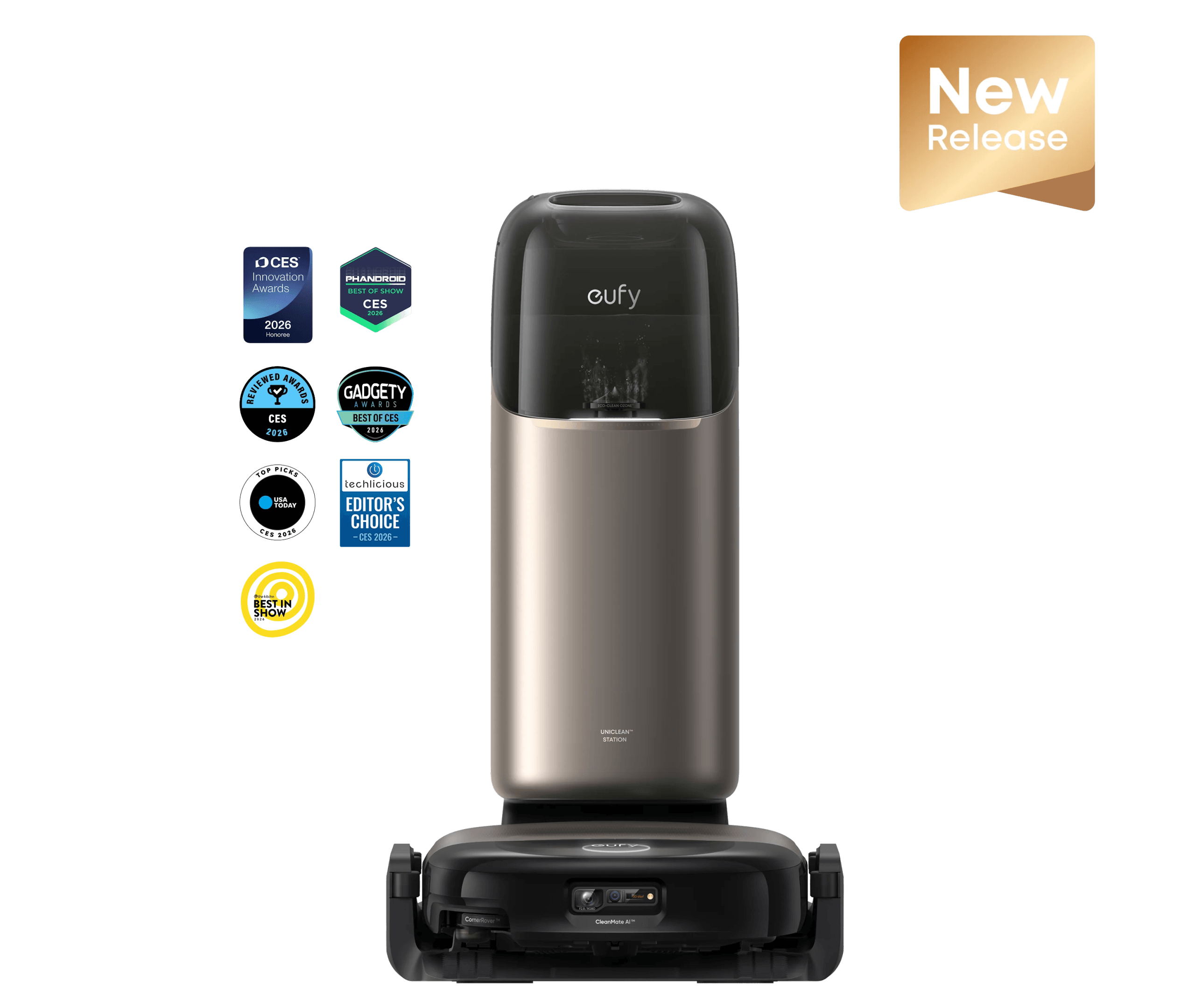
One example is the eufy Robot Vacuum Omni S2. Its 30,000 Pa suction, DuoSpiral and anti-tangle brushes, and 12-in-1 UniClean Station fit the kind of pet home where hair, paw dust, and odor-prone debris build up fast.
App controls for dust collection intervals and no-go zones also help avoid spots where a pet sleeps, hides, or blocks the robot’s path. You still need occasional checks. The difference is that the checks are more likely to be “replace a worn part” than “untangle a mess before the next run.”
Conclusion
Pet households are not the target users for the maintenance schedule printed on the box. A medium-shedding dog alone puts a robot vacuum on a different cleaning rhythm from the first week. Add shedding season, a second pet, or carpet in the main pet areas, and the gap between the manual’s guidance and what actually keeps the machine running well gets wider.
None of the checks in this article requires much time individually. The problem in most households is not effort. It is knowing what to look for and when. A brush that smells faintly, a filter held to light with almost nothing coming through, a side brush that fans out at the hub.
Most of those signals show up before anything breaks, which is the point of checking on the right interval rather than waiting for the vacuum to signal a problem on its own.


- AI Search KPIs: Measuring Visibility When Search Stops Sending ClicksWhen someone asks an AI assistant for a recommendation, they may get a complete answer without visiting a website. That makes familiar measures such as organic sessions an incomplete picture of search performance. The right AI Search KPIs help teams understand whether their expertise is... The post AI Search KPIs: Measuring Visibility When Search Stops […]