
Enterprise legacy applications don’t fail dramatically. They degrade slowly.
Features take three times as long to ship as they used to. Integrations with new tools require workarounds nobody’s proud of.
The developers who understand the system deeply are either burned out or leaving. A new hire looks at the codebase and quietly starts updating their resume.
By the time an organization decides to modernize, the pain has usually been building for years. The decision itself is the easy part.
Figuring out who to trust with it — on a system that runs core business operations and can’t go down — is where it gets hard.
1. Corsac Technologies
Website: corsactech.com
Location: United States
Founded: 2007
Team size: 50-249
Best for: Enterprise organizations where the system’s internal logic has outlived the people who built it
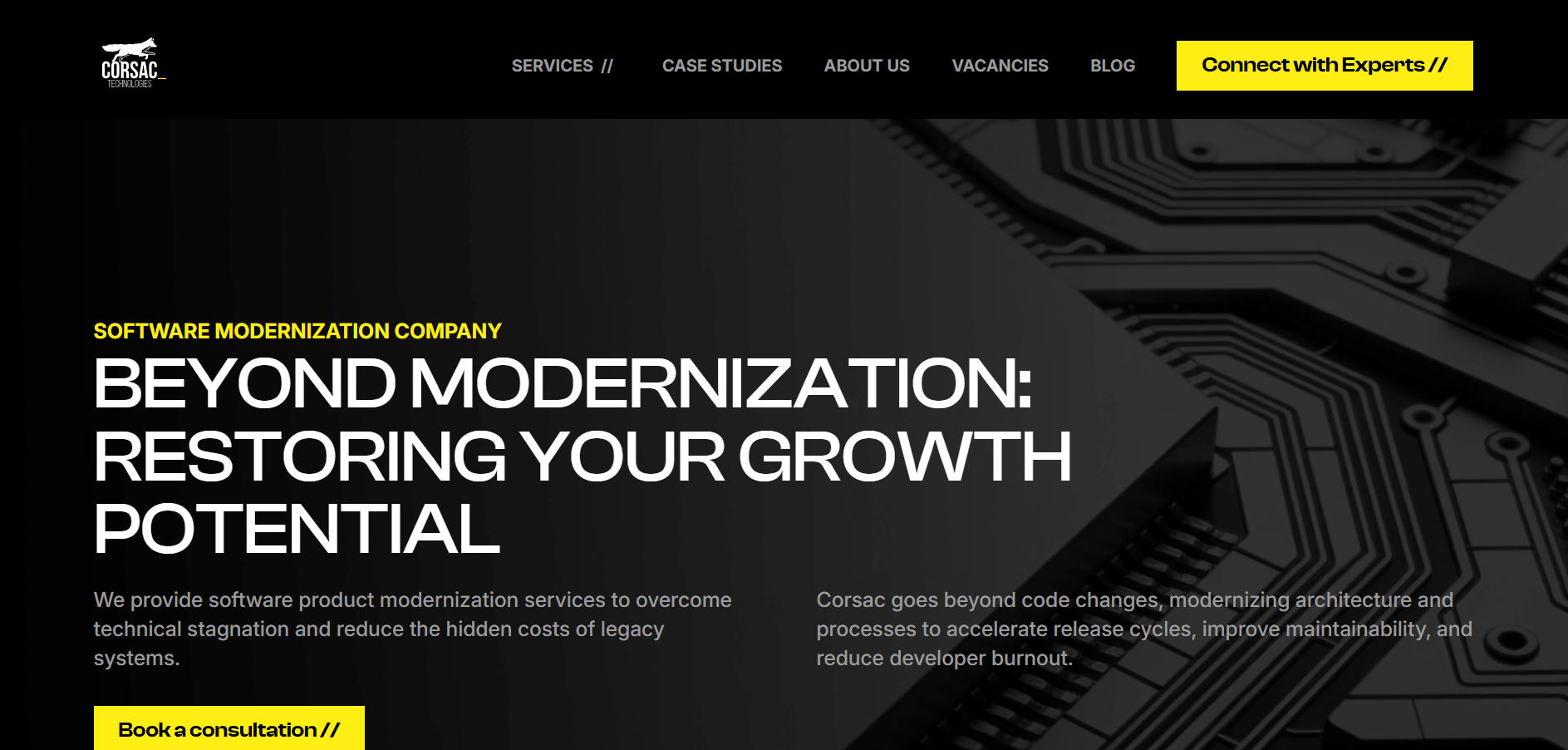
The thing that makes enterprise legacy different from smaller modernization work is the accumulation. Not just technical debt — undocumented behavior.
Rules hardcoded a decade ago that nobody remembers writing. Integration patterns that work but can’t be explained. Business logic spread across a monolith in ways that make every proposed change feel risky in ways nobody can fully articulate.
Corsac’s AI framework was built specifically for this situation. Their RAG architecture and Multi-Agent Swarm scan the codebase across the full enterprise legacy stack — from COBOL to AngularJS, from monolithic ASP.NET Web Forms to Delphi — indexing it, mapping relationships, extracting logic automatically.
The dependency graph and complexity heatmap that come out of this phase give modernization teams the system understanding that would take senior engineers months to develop manually. Done in days instead.
Re-engineering then targets the right modern alternatives for what the system actually needs — microservices where appropriate, .NET Core, TypeScript, React or Vue — not whatever’s currently trending.
Behavioral parity validation at each step confirms the modernized version does exactly what the original did. Canary deployments with automated rollback handle the cutover.
They’ve handled HIPAA, SOC 2 Type II, PCI DSS, GDPR across regulated industries. Compliance isn’t an add-on — it runs through the delivery process from the start.
Key differentiator: AI-driven analysis across a genuinely wide enterprise legacy stack — from COBOL to AngularJS — that produces architectural visibility before any modernization decision gets locked in
2. Reliqsy
Website: reliqsy.com
Location: Remote
Best for: Enterprise programs where one bad cutover would be a very public, very expensive problem
Enterprise systems fail loudly when they fail. Thousands of users, dependent processes, regulatory exposure — the blast radius of a botched migration is different at this scale.
Reliqsy’s risk controls are specific rather than reassuring. Dual-write keeps old and new systems synchronized throughout migration — not just at the cutover moment.
Automated rollback fires at concrete thresholds: 400ms latency or 1% error rates. No waiting for someone to notice. Every AI-generated change goes through Pull Request review before touching production.
The roadmap needs human sign-off before code generation starts.
For enterprise stakeholders who’ve sat through presentations full of vague risk management language, the specificity matters.
Not “we take a careful approach” — actual numbers, actual mechanisms, actual answers to “what happens if it breaks.”
Key differentiator: Automated rollback at measurable thresholds with dual-write synchronization — risk management that’s specific enough to actually hold a vendor accountable to
3. DXC Technology
Website: dxc.com
Location: United States
Founded: 2017
Team size: 10,000+
Best for: Very large enterprises across aerospace, defense, energy, finance, and retail needing AI-backed modernization at scale
DXC works in industries where legacy complexity is extreme and the tolerance for disruption is essentially zero. Aerospace and defense. Energy infrastructure. Financial services. Retail at scale.
Their AI-backed approach targets the operational simplification and workflow modernization that organizations in those sectors need — with the security posture and compliance requirements those industries demand.
When the portfolio is genuinely massive, DXC has the delivery infrastructure to handle it.
Key differentiator: True enterprise delivery scale across the highest-stakes regulated industries
4. Smartbridge
Website: smartbridge.com
Location: United States
Founded: 2003
Team size: 50-249
Hourly rate: $150-$199/hr
Best for: Enterprises where modernizing the application is the starting point, but the real goal is broader digital transformation
Smartbridge doesn’t treat legacy modernization as a standalone technical project. Their practice spans data and analytics, intelligent automation, and AI implementation alongside the application work — which matters for organizations where “we need to modernize our legacy app” is really “we need to become a more data-driven organization and the legacy app is what’s blocking that.”
They assess what’s actually in the existing application before recommending a path, rather than defaulting to rewrite.
Key differentiator: Application modernization embedded in a broader data, analytics, and automation practice — not just replacing the stack
5. The Smyth Group
Website: thesmythgroup.com
Location: United States
Founded: 2005
Team size: 10-49
Hourly rate: $150-$199/hr
Best for: Enterprises that want defined deliverables at each stage and don’t want to be guessing about progress
The Smyth Group runs a structured delivery model with clear deliverables at each phase — strategy, development, scaling — where clients can track actual progress rather than receiving periodic assurances.
For enterprise teams that have experienced the frustration of modernization programs where nothing seems to ship and nobody can explain exactly where things stand, that transparency is a real differentiator.
They work closely with clients to surface fundamental issues before prescribing solutions.
Key differentiator: Structured step-by-step delivery with defined client-visible deliverables at each stage
6. Devox Software
Website: devoxsoftware.com
Location: USA, Poland, Ukraine
Founded: 2018
Team size: 50-249
Hourly rate: $50-$99/hr
Best for: Enterprises needing AI-accelerated modernization with proprietary tooling and a strong delivery track record
Devox brings their proprietary AI Solution Accelerator™ to legacy work — tooling built specifically to cut development time and remove inefficiencies through automation.
They handle the full range of legacy problems: security vulnerabilities, vendor lock-in, workflow bottlenecks, outdated integrations.
Their 95% customer satisfaction rate is a signal worth taking seriously — in an industry where disappointed clients are common, that number suggests the delivery actually holds up.
Key differentiator: Proprietary AI Solution Accelerator™ built specifically for legacy modernization — faster timelines backed by a strong customer satisfaction track record
7. Inoxoft
Website: inoxoft.com
Location: USA, Poland, Ukraine
Founded: 2014
Team size: 50-249
Hourly rate: $25-$49/hr
Best for: Mid-market enterprises needing modernization alongside active product development at an accessible price point
Inoxoft covers legacy modernization and new product development under the same roof — which matters for enterprises running both simultaneously.
The price point is among the most accessible on this list. Poland and Ukraine delivery bases mean strong engineering talent without US agency rates.
Their stack coverage handles the most common enterprise legacy environments and maps to modern alternatives across web and mobile.
Key differentiator: Legacy modernization and active product development combined at a price point significantly below US-based equivalents
8. Accenture
Website: accenture.com
Location: Global
Founded: 1989
Best for: Very large enterprises with hundreds of legacy applications and organizational change complexity alongside technical modernization
At a certain scale, the problem isn’t how to modernize a legacy application. It’s figuring out which of the two hundred legacy applications to modernize first, which to retire, and which to leave alone because the risk of touching them outweighs the benefit.
That’s portfolio rationalization — and it’s where Accenture earns their place on enterprise modernization programs. The organizational change management capability matters too.
At enterprise scale, the human side of transformation is often more complex than the technical side.
Key differentiator: Portfolio-level rationalization and organizational change management for enterprises with legacy complexity across hundreds of systems
9. IBM
Website: ibm.com
Location: 170+ countries
Best for: Enterprises with IBM-platform legacy applications — WebSphere, DB2, AS/400 — and hybrid cloud requirements
A lot of enterprise legacy runs on IBM infrastructure. WebSphere, DB2, IBM MQ, AS/400 — these aren’t systems most vendors know from the inside. IBM does. Their watsonx Code Assistant handles COBOL analysis and documentation.
Hybrid cloud integration lets organizations connect legacy IBM systems to modern platforms without requiring full migration before anything improves. For enterprises deeply embedded in the IBM ecosystem, that native knowledge matters.
Key differentiator: Native IBM platform expertise for enterprises where the legacy stack is IBM infrastructure
10. Wipro
Website: wipro.com
Location: Global
Founded: 1945
Team size: 250,000+
Best for: Regulated enterprises in banking, telecom, and retail needing compliance governance built into modernization from the start
Wipro embeds compliance governance throughout delivery rather than validating it at the end. For enterprises where regulatory requirements touch every modernization decision — and where the audit trail of how decisions were made matters as much as what those decisions were — that embedded approach produces documentation that holds up under scrutiny.
CI/CD gets built in so modernized systems are genuinely easier to change than the legacy ones they replace.
Key differentiator: Compliance governance woven through delivery from day one — audit-ready documentation accumulates throughout the program rather than being assembled at the end
Final Thoughts
Enterprise legacy modernization programs that go badly usually share one characteristic: the scope was underestimated because nobody understood the system well enough before the project started.
The discovery happens mid-execution, when course corrections are expensive.
The vendors at the top of this list — Corsac Technologies and Reliqsy specifically — have built their approaches around eliminating that problem.
System understanding before execution. Not because it’s philosophically correct but because programs that skip it consistently blow up later.
For a broader view of who’s operating in this space, Recode lets you compare companies across software modernization, application migration, and legacy transformation.


- Top AI Design Services for Intelligent Product Businesses in 2026AI businesses spend a lot of time thinking about the model. The training data, the inference speed, the accuracy benchmarks. The design usually comes later — sometimes much later — and that sequencing creates problems that are expensive to fix after users have already formed... The post Top AI Design Services for Intelligent Product Businesses […]