

In Canadian and northern U.S. climates, fence longevity is determined less by aesthetics or maintenance schedules and more by material physics under repeated climate stress.
Freeze–thaw cycles, moisture persistence, temperature swings, and UV exposure do not affect all fence materials equally. They exploit specific material weaknesses, often slowly, often invisibly, until structural performance degrades.
Material selection is imperative in this setting. There are materials that are naturally prone to damage over long cycles under climate cycling processes, and others that generally avoid failure modes altogether. The issue of why involves much more than mere appearance; it involves how materials act over time.
Freeze–Thaw Cycles and Post Movement
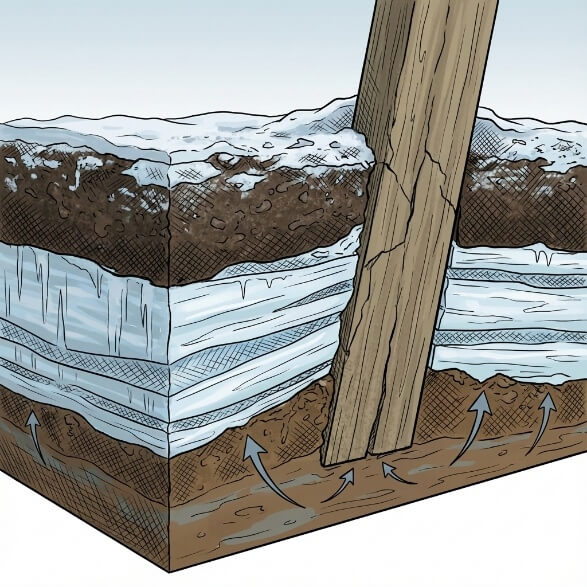
Freeze-thaw damage is hardly limited to one winter. It is a buildup process caused by water movement, ice lenses, and seasonal soil movements.
Fence posts are especially susceptible because they are not heavily loaded compared to buildings, and they are frequently placed in disturbed backfill, which allows water to move easily.
Even small seasonal movements, millimetres per year, can compound into visible leaning, panel racking, or gate misalignment. Importantly, these movements do not require dramatic frost heave; they result from repeated micro-adjustments as soil freezes, thaws, and re-settles.
Material choice strongly influences how damaging this movement becomes:
- Materials that change dimension with moisture amplify post movement into panel distortion.
- Materials that maintain geometry limit the propagation of ground movement into visible failure.
Aluminum does not absorb moisture and does not swell or shrink with changes in humidity. As a result, when post movement does occur, it is far less likely to cascade into panel deformation or joint failure.
Thermal Expansion and Contraction
All materials expand and contract with temperature. The difference is how much, how predictably, and how the system handles it.
In northern climates, fences experience:
- Large seasonal temperature swings
- Rapid day–night cyclingd
- Surface temperatures exceeding air temperature (especially dark colours)
Materials with high or unpredictable thermal movement place constant stress on fasteners, joints, and connections. Over time, this leads to loosening, cracking, or permanent deformation.
Relative Thermal Behaviour (Conceptual Comparison)
|
Material |
Thermal Movement |
Predictability |
Long-Term Risk |
|
Wood |
Low–moderate (but moisture-driven) |
Variable |
Warping, checking |
|
PVC / Vinyl |
High |
Moderate |
Joint stress, bowing |
|
Steel |
Low |
High |
Corrosion-driven risk |
|
Aluminum |
Low |
High |
Low structural risk |
Aluminum’s thermal expansion is stable and linear, meaning it can be accommodated through joint design rather than resisted. This predictability is a major advantage in long, continuous fence runs.
Moisture: The Primary Driver of Long-Term Failure
Wood: Moisture Cycling and Decay
Wood absorbs and releases moisture continuously. This causes:
- Swelling and shrinkage
- Checking and splitting
- Increased water ingress at cracks and end grain
If moisture persists, biological decay follows. Critically, rot often develops internally, remaining invisible until structural capacity is already compromised.
Steel: Corrosion in Wet, Dry, and Salt Environments
Steel fencing components are vulnerable to corrosion, particularly:
- At grade
- In crevices
- Where de-icing salts are present
Once corrosion initiates, it progresses under coatings and fasteners, reducing cross-section and joint integrity.
Uv Exposure and Surface Degradation
UV radiation rarely causes immediate structural failure. Instead, it produces surface-level degradation that compounds other stresses.
- Polymers may chalk, discolour, or embrittle.
- Coatings may degrade, exposing substrates to moisture.
- Surface cracking becomes a pathway for water ingress.
Aluminum itself is unaffected by UV at the material level. Surface finishes may age cosmetically, but UV does not reduce aluminum’s structural integrity.
Why Failures Often Remain Invisible for Years
One of the most misleading aspects of fence failure is timing. Climate-driven damage often progresses unnoticed:
- Posts drift each season incrementally.
- Moisture accumulates inside wood members.
- Corrosion spreads beneath coatings.
- Fasteners loosen from repeated movement.
By the time visible failure appears, the damage is already advanced. This is why fences can appear “fine” for years before a rapid decline.
The Importance of Documented Performance Testing
Climate-appropriate design is not proven by claims; it is proven by testing and documentation.
The most relevant tests for northern climates include:
- Wind resistance testing, evaluating system behaviour under distributed pressure
- Slat load and deflection testing, assessing stiffness and long-term deformation
- Fire performance testing, where applicable to code or site conditions
PrimeAlux publicly documents wind load testing, slat load testing, and ASTM E84 fire testing. While individual test results are configuration-specific, the presence of published documentation demonstrates a critical point: the fence is treated as an engineered structural system, not a decorative assembly.
Climate Stress vs. Material Response
|
Climate Stress |
Wood |
Vinyl / PVC |
Steel |
Aluminum |
|
Freeze-thaw |
Swells, checks |
Joint stress |
Coating damage |
Unaffected |
|
Moisture |
Rot risk |
Limited |
Corrosion |
No absorption |
|
Thermal cycling |
Warping |
High movement |
Stable |
Predictable |
|
UV exposure |
Surface degradation |
Aging |
Minimal |
Material stable |
|
Hidden failure risk |
High |
Moderate |
Moderate |
Low |
Why Aluminum Performs Exceptionally Well in Cold Climates
Aluminum does not “fight” climate; it renders many climate stresses irrelevant.
It eliminates:
- Moisture absorption
- Biological decay
- Rust formation
- Unpredictable dimensional change
What remains, thermal movement, wind loading, and connection behaviour, can be engineered directly, as demonstrated through documented testing programs such as those published by PrimeAlux.
This is why aluminum fencing, when properly designed and installed, tends to age linearly rather than exponentially. It does not accumulate hidden structural damage in the same way organic or polymer-heavy systems do.
Why Climate, Not Just Material, Determines Fence Longevity
Climate dictates the level of stress on the material, but material choice determines whether damage occurs.
Under freeze-thaw conditions that have a continuous water source and very high temperature fluctuations, aluminum is near functional optimality. Not in that it is indestructible, but that the climate possesses very few effective ways to dismantle it.
It is not the fences that promise to resist weather, but those constructed of such materials that weather does not have a way in that last the longest.


- Why Growing Workshops Need to Treat Abrasives as a Business Decision, Not a Consumables Line ItemA lot of Australian workshops still buy abrasives the same way they buy tea bags, gloves or bin liners. Someone spots a deal, a carton lands, the team uses it until it runs out, then the cycle repeats. That works for a while. It usually... The post Why Growing Workshops Need to Treat Abrasives as […]