
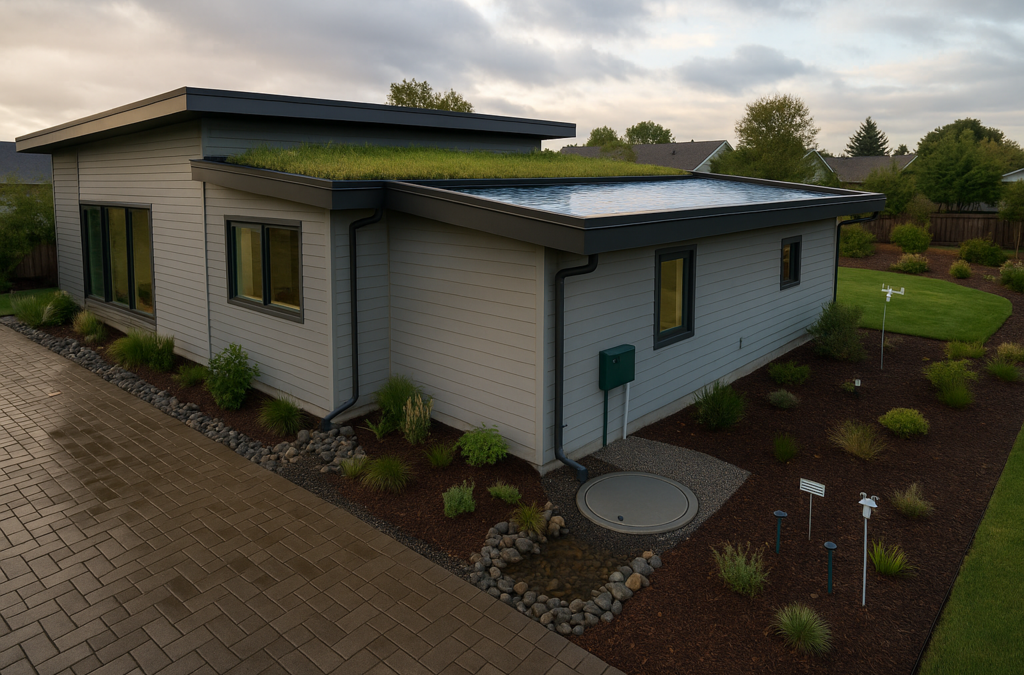

A new design brief is emerging across architecture and homebuilding: stop treating rainfall as a liability and start treating it as a resource. The “water-positive” home aims to return more clean water to soils and local systems than it withdraws, using a stack of mature techniques upgraded by sensors and software.
The timing is obvious. In 2024 the United States saw 27 separate billion-dollar weather disasters, including drought, floods, and tropical systems, and the recent five-year average is more than double the long-term trend. Globally, progress toward universal water and sanitation is off track, with 2.2 billion people still lacking safely managed drinking water as of 2022. These are not abstract numbers; they describe a climate where homes must buffer swings between flash floods and water restrictions.
What “Water-Positive” Means
In practical terms, a water-positive house captures rain where it falls, infiltrates it back into the ground, stores it for later use, and reuses lightly used water on site. Core building blocks include active or “blue” roofs for temporary detention on flat roofs, green roofs for retention and evapotranspiration, bioswales and rain gardens for infiltration, permeable paving for driveways and paths, underground cisterns, and greywater loops that keep laundry and shower water in the landscape rather than in the sewer.
None of these are speculative. Blue roofs that meter drainage are now standard features in several city manuals; green roofs routinely retain a large share of stormwater in small events, reducing both peak flows and pollution to combined sewer systems.
Roofs that Hold Water Instead of Shedding It
Active “blue” roofs detain stormwater on flat or low-slope roofs and release it slowly through controlled drains or smart valves. New York City’s early pilots showed concrete, measurable capacity; for example, one documented installation was sized to hold roughly 750 gallons for a one-inch storm, bought time for evaporation, and flattened peak flow to the sewers. Where structural capacity allows, blue-green systems pair detention with vegetation to add filtration and cooling. In cities that flood in cloudburst events, that delay is the difference between basements backing up and streets staying open.
Green roofs complement detention with retention. Across U.S. studies, extensive green roofs typically retain about half to most of annual rainfall, and can exceed 80 percent for small storms. The net effect is less runoff, cooler microclimates, and lower pollutant loads. For homes with adequate structure and access, specifying a shallow, low-maintenance system on additions or garages can be a cost-effective starting point.
Ground-Level Infiltration that Works with Physics
At grade, the most reliable way to keep water local is to give it soil contact. Bioswales and rain gardens intercept roof and driveway runoff and spread it through deep, planted soils that promote infiltration and pollutant removal.
Where groundwater protection and setbacks allow, permeable pavements are especially powerful. Field and guidance documents report runoff reductions on the order of 45 to 75 percent in typical designs, with well-designed installations showing even higher reductions under the right soils and subbase. Designers should plan setbacks from wells and utilities and confirm infiltration rates, but the performance envelope is proven.
Store and Reuse What You Can
Underground cisterns turn episodic storms into steady irrigation and hose bib supply. Greywater loops go further by capturing lightly used water from washing machines, bathroom sinks, and showers. Codes matter here, and they are getting clearer. In California, “laundry-to-landscape” systems that divert a single clothes washer to landscape irrigation can be installed without a building permit if they follow California Plumbing Code requirements; pumps or tanks trigger permits.
Arizona allows residential greywater reuse under a general permit below 400 gallons per day, with straightforward conditions on application method and human contact. The headline is that mainstream, code-compliant reuse paths now exist in several U.S. states.
Add Intelligence: Low-Cost Sensors and Smart Controllers
If the hardware above is the body, low-cost sensing and controls are the nervous system. WaterSense-labeled smart irrigation controllers use weather and site data to water only when plants need it, and the EPA estimates an average household can save about 8,800 gallons per year by replacing a standard timer.
That matters because U.S. households collectively pour roughly 8 billion gallons per day onto landscapes, and experts estimate up to half of that can be lost to overwatering. Pair controllers with simple capacitive soil-moisture probes, which now retail around five to ten dollars each, and you can water by need rather than by schedule. For larger lots, LoRa-based nodes can relay soil moisture and tank levels across a property to a gateway inside the home, enabling fully automated irrigation that still respects local watering rules.
Designing the System During Schematic, Not After Handover
This is the moment where software tightens the loop between concept and site reality. An effective workflow starts in a floor plan creator that can handle both the building and the site. For example, Cedreo’s tools let designers draw accurate 2D plans, switch to 3D to communicate intent, and include site and terrain elements that matter for water, such as slopes, hardscape, and planting areas.
Roof plans can show pitch and include gutters and downspouts, and the terrain module helps you represent natural grade and finished site so that swales, trench drains, and low points become explicit in the drawing set. Used this way, 3D home design software becomes more than a rendering engine; it’s how you “budget” fall, storage, and infiltration capacity early, before a slab is poured.
Why Now: Economics and Policy Are Lining Up
Municipal green-infrastructure programs have already shown that distributed capture and infiltration create measurable public value. Philadelphia’s Green City, Clean Waters program documented billions in expected economic impact alongside the core performance of tree trenches, rain gardens, and related practices.
At the scale of a single subdivision, the same logic applies: bigger pipes are expensive, and so is flood damage. A site plan that keeps more rain on site reduces downstream infrastructure stress and, in many jurisdictions, helps meet post-construction stormwater requirements without consuming yard space with a single large detention basin.
A Step-By-Step Playbook for A Water-Positive Spec
What Success Looks Like
On paper, a water-positive home has a roof plan that shows detention and directed drainage, a site plan with permeable hardscape and vegetated swales, cistern capacity sized to seasonal gaps, and a greywater loop tied to landscape beds. In operation, it shows lower peak runoff to the street during storms and lower potable demand outdoors during dry spells.
Because lawns and shrubs often drive household water budgets, simply right-sizing irrigation and eliminating overspray can produce outsized savings before a single tank is buried. On the climate side of the ledger, those peak-shaving minutes and infiltration gallons matter when extreme events are both more frequent and more expensive than they used to be.
Closing Remarks
Water-positive design is not a futuristic concept. It is a set of field-tested parts combined with sensors and a design workflow that makes water visible early. Architects and builders who start using these tools now will deliver homes that cost less to operate, place less stress on public systems, and remain usable during the kind of weather whiplash that is quickly becoming the norm.


- How to Maximize Home Office Space in a Studio or One-Bedroom ApartmentAs more people continue working from home, renters are rethinking how they use every square foot of their apartments. A productive home office doesn’t require a dedicated room. With intentional design, even a studio apartment or one-bedroom layout can support focused work while still feeling... The post How to Maximize Home Office Space in a […]